Book
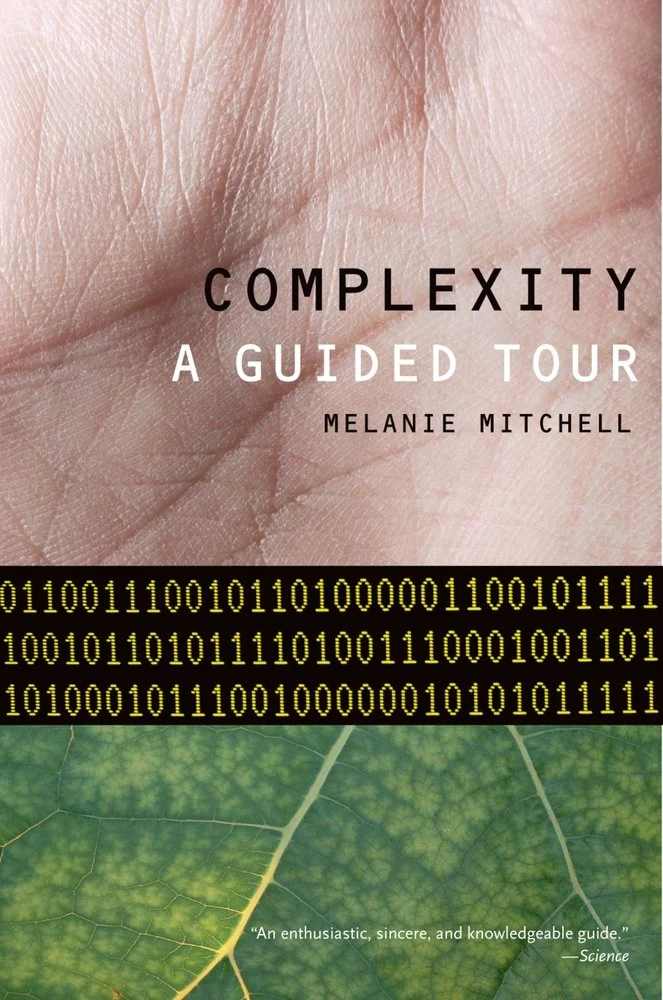
Complexity
A Guided Tour
- Melanie Mitchell · Author
Complex systems produce surprising patterns from many interacting parts. Complexity introduces the science of complex systems across computation, biology, evolution, networks, and adaptation.
Find this book ↗Melanie Mitchell offers an accessible overview of complexity science. The book helps readers understand emergence, adaptation, computation, and the difficulty of prediction in systems with many interacting agents.
Many systems cannot be understood by analyzing their parts in isolation. Complexity science studies systems where interaction produces behavior that no single component controls.
Mitchell introduces core ideas such as emergence, self-organization, adaptation, networks, and computation. The book moves across disciplines, showing similarities between biological, social, and technological systems.
A central lesson is that complexity resists simple cause and effect. Patterns arise over time through feedback and interaction. Understanding these systems requires humility and multiple lenses.
The book provides a broad foundation for seeing systems in motion.Why this belongs here: Knowledge Flow often operates inside complex adaptive environments. This book belongs here because it gives readers a vocabulary for emergence, interaction, and nonlinear change.
Why this belongs here
Knowledge Flow often operates inside complex adaptive environments. This book belongs here because it gives readers a vocabulary for emergence, interaction, and nonlinear change.