Book
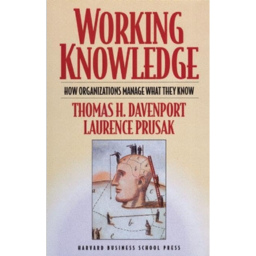
Working Knowledge
How Organizations Manage What They Know
- Laurence Prusak · Co-author
Working Knowledge explains why knowledge—not data or information—is the true source of organizational value, and shows how social systems, culture, and incentives determine whether knowledge actually produces results.
Find this book ↗This influential book establishes the enduring vocabulary and concepts in the burgeoning field of knowledge management. It serves as the hands-on resource of choice for companies that recognize knowledge as the only sustainable source of competitive advantage going forward. Drawing from their work with more than thirty knowledge-rich firms, Davenport and Prusak--experienced consultants with a track record of success--examine how all types of companies can effectively understand, analyze, measure, and manage their intellectual assets, turning corporate wisdom into market value. They categorize knowledge work into four sequential activities--accessing, generating, embedding, and transferring--and look at the key skills, techniques, and processes of each. While they present a practical approach to cataloging and storing knowledge so that employees can easily leverage it throughout the firm, the authors caution readers on the limits of communications and information technology in managing intellectual capital.
In Working Knowledge, Thomas H. Davenport and Larry Prusak dismantle the assumption that better databases, documents, or IT systems are sufficient to make organizations smarter. They draw a clear and influential distinction between data, information, and knowledge, arguing that knowledge is inherently human, contextual, and action-oriented. Through case studies and practical analysis, the book demonstrates that knowledge cannot simply be “managed” as an object—it must be supported through trust, shared practices, and environments that encourage learning, judgment, and reuse.
The book reframes organizational performance around knowledge flow: how insight is created, shared, applied, and sustained over time. Davenport and Prusak show that companies fail not because they lack information, but because they misunderstand how knowledge emerges and compounds within real work. By treating knowledge as a productive force shaped by culture, incentives, and relationships, Working Knowledge laid the foundation for modern thinking on knowledge-centered strategy, organizational learning, and long-term adaptive capability.