People · Systems Library
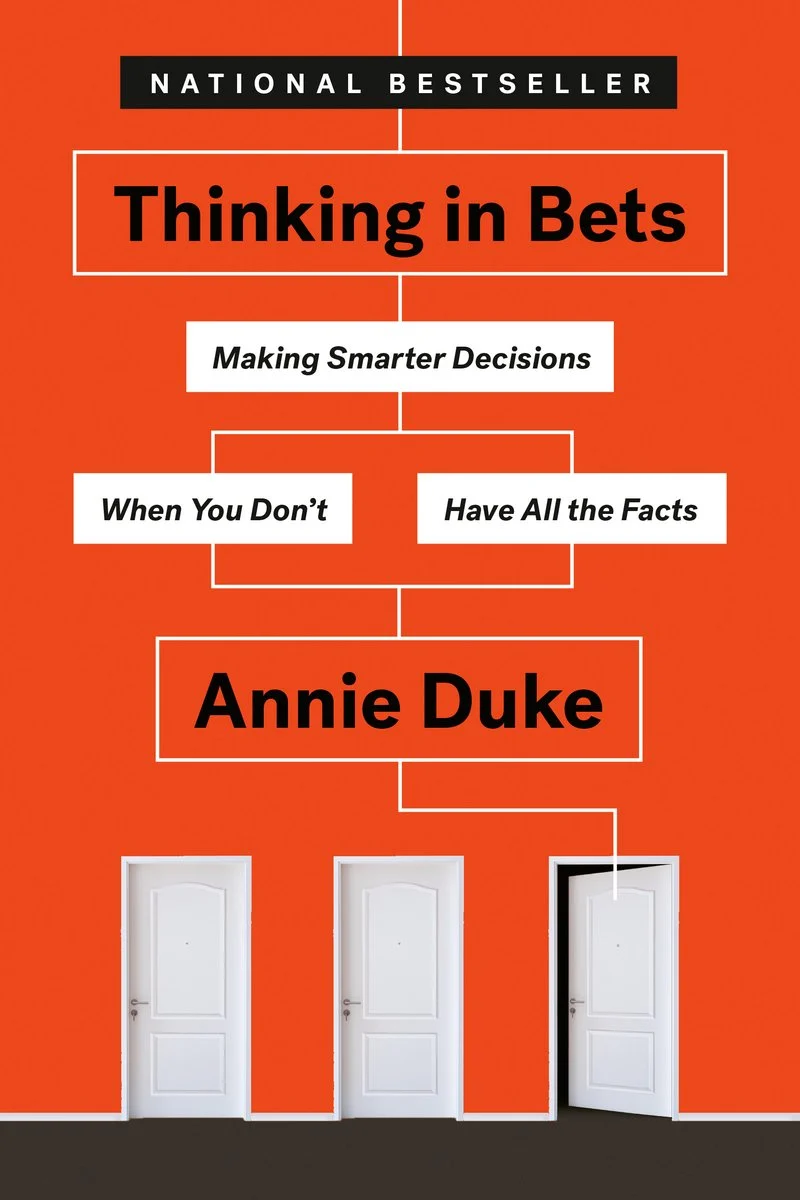
Annie Duke
Annie Duke explores decision-making under uncertainty, emphasizing probabilistic thinking, cognitive bias awareness, and the distinction between good decisions and good outcomes.
Visit their website ↗Annie Duke is a decision strategist, author, and former professional poker player whose work focuses on uncertainty, risk, and adaptive thinking. She is known for helping people improve decision quality in environments where outcomes are unpredictable and incomplete information is unavoidable.
Annie Duke’s work examines how people make decisions in conditions of uncertainty — environments where outcomes are shaped by probability, incomplete information, timing, hidden variables, and luck as much as skill or intention.
Drawing from her background in professional poker, Duke challenges the common human tendency to judge decisions primarily by outcomes. A good decision can produce a poor result; a poor decision can occasionally succeed. This distinction is foundational to learning intelligently within complex systems.
Her work emphasizes probabilistic thinking: evaluating confidence, uncertainty, assumptions, and alternative possibilities rather than treating decisions as binary certainties. She frequently explores how cognitive biases, emotional attachment, hindsight distortion, and overconfidence undermine adaptive learning.
Rather than pursuing perfect certainty, Duke advocates building systems and practices that improve judgment over time through reflection, calibration, and iterative learning.
Relevance to Knowledge Flow
Duke’s work reinforces a core principle of Knowledge Flow: intelligence is not certainty.
Knowledge systems often fail because people become overly attached to being right, protecting identity or authority instead of learning from reality. Duke’s emphasis on probabilistic thinking helps cultivate epistemic humility and adaptive reasoning within uncertain environments.
Her work also highlights the importance of separating learning from outcome bias. Knowledge Flow depends on creating systems capable of reflection, recalibration, and iterative improvement rather than simplistic success/failure narratives.